 Status






































































Anyone running Kubernetes in Switzerland will eventually face a decision: self-host, choose a local managed provider, or go with a hyperscaler. All three options work. They differ significantly in what your team needs to do afterwards.
This post compares the main options honestly, including where we ourselves are stronger or weaker.
Option 1: Self-hosted Kubernetes
Running Kubernetes on your own or rented infrastructure gives you maximum control. But that control comes at a price: the full Day-2 Operations burden falls on your own team.
What this means:
- Cluster upgrades three times a year, coordinated manually (minor releases cannot be skipped; going from 1.34 directly to 1.36 is not supported)
- Managing the upgrade sequence yourself: control plane first, then each node individually via cordon/drain/upgrade/uncordon
- Setting up and maintaining the observability stack (Prometheus, Grafana, Loki) internally
- Security patches, cert-manager, secret management, and backups (all in-house)
- Kubernetes Secrets are not encrypted by default: Encryption at Rest or an external secret store must be actively configured
- Training or hiring CKA-certified engineers internally
There are also decisions that need to be made before the first cluster is up, and which are difficult to revisit later: which Kubernetes distribution? (kubeadm, K3s, or RKE2, each with its own upgrade path.) Which CNI plugin? (Cilium, Calico, and Flannel differ significantly in their Network Policy capabilities and performance profiles.) Which ingress controller? (Note: ingress-nginx was retired in March 2026; HAProxy or Traefik are now the recommended alternatives.) High availability requires at least three control plane nodes for etcd quorum. These are all solvable problems, but every decision means expertise that needs to be built and maintained over time.
Makes sense when: Your team has deep Kubernetes expertise, time for platform operations, and specific requirements no managed provider covers.
Honest assessment: For most Swiss SMEs and scale-ups, self-hosted is a hidden cost trap. The initial setup is manageable; the ongoing operations burden almost every team underestimates.
Option 2: Exoscale SKS
Exoscale is the most direct Swiss competitor in the Kubernetes space. SKS (Scalable Kubernetes Service) is hosted in Europe and CNCF-certified.
What Exoscale does well:
- Free starter cluster: very low entry barrier
- Fast cluster provisioning
- CNCF-certified platform
- Transparent, per-second billing
- Kubernetes Metrics Server enabled by default
- Kubernetes audit logs available via webhook (PRO tier, Kubernetes 1.31+)
- Karpenter as a managed add-on (PRO tier): automated node lifecycle, and after a cluster upgrade new nodes automatically run the new Kubernetes version
- Separate managed databases (PostgreSQL, MySQL, Kafka, OpenSearch, Valkey) available in the same ecosystem, plus managed Grafana and Thanos as observability building blocks
- Direct access to Exoscale’s in-house engineers, with phone support from the Pro support plan and 24/7 support with the Enterprise plan
Note on ownership: Exoscale was founded in Lausanne and is domiciled in Switzerland. Exoscale is a 100% subsidiary of the A1 Telekom Austria Group (via A1 Digital International GmbH). This is not automatically a disqualifier, but it is relevant for companies with strict requirements around Swiss ownership, even if the infrastructure is operated in Switzerland and the EU.
Where the limits are:
- SKS is a managed control plane, not a managed stack. Monitoring, logging, backups, GitOps: these stay with the customer.
- No ready-made, integrated observability stack out of the box: the building blocks (managed OpenSearch, Thanos, Grafana) are separate services that need to be assembled yourself
- Without Karpenter, node pools have to be cycled manually after an upgrade; minor version upgrades of the control plane are triggered by the customer
Makes sense when: You have Kubernetes expertise in-house, want to outsource only the control plane, and are looking for a cost-effective entry point.
Option 3: Hyperscalers (AWS EKS, Azure AKS, Google GKE)
Hyperscalers offer the broadest ecosystem and highest global scalability. For many international products, this is the right choice.
What hyperscalers do well:
- Vast ecosystem of integrated services
- Global multi-region deployments
- Partially free control planes (AKS, GKE Autopilot)
- Latest Kubernetes features first
Where the limits are:
- AWS, Azure, and Google are US companies. Their data centres in Zurich or Frankfurt don’t change that: building on US infrastructure means falling under the CLOUD Act. (Note: AWS launched a European Sovereign Cloud in Germany in January 2026, explicitly designed to address CLOUD Act concerns, but it is not yet available in Switzerland.)
- Costs are difficult to predict (“bill shock”)
- The managed portion is typically limited to the control plane, the rest stays with the customer
- No personal support: ticket systems, no direct contact person
Makes sense when: Global scale is the priority, data sovereignty is not a concern, and you budget for hyperscaler costs.
Option 4: VSHN (APPUiO Cloud / VSHN Managed OpenShift)
VSHN is a Swiss company based in Zurich. APPUiO Cloud is their shared managed OpenShift platform; VSHN Managed OpenShift (formerly APPUiO Managed, renamed February 2025) is a dedicated variant for your own clusters.
Important note on scope: This section describes APPUiO Cloud and VSHN Managed OpenShift, VSHN’s OpenShift-based flagship products. VSHN previously also offered Managed Kubernetes on EKS, GKE, AKS, and Exoscale SKS, but these products have since been deprecated. VSHN’s current focus is on OpenShift-based managed platforms.
What VSHN does well:
- Fully hosted and operated in Switzerland
- Managed platform including monitoring, logging, and backups
- Strong focus on compliance and regulated industries
- Experienced team with broad open-source expertise
Where the limits are:
- Both products are based on OpenShift (Red Hat): teams that want to switch platforms later carry OpenShift-specific dependencies with them
- Pricing structure is less transparent than usage-based billing
- Primarily enterprise-focused; entry for smaller teams is comparatively complex
Makes sense when: You are looking for an OpenShift environment, already have Red Hat experience in your team, and require Swiss data sovereignty.
Option 5: Swisscom Sovereign Kubernetes Service
Swisscom launched a Sovereign Kubernetes Service (GA) in August 2025, built on the Kubermatic Kubernetes Platform (KKP). It runs exclusively in Swiss data centres, is CNCF-certified, and had around 390 production clusters with over 2,100 worker nodes in operation as of April 2026.
What Swisscom does well:
- Exclusively in Swiss data centres, full Swiss data sovereignty
- Swiss ownership: majority-owned by the Swiss Confederation
- CNCF-certified Kubernetes
- Enterprise-grade SLA backed by Switzerland’s largest telecom provider
- Significant production footprint after less than one year of general availability
Where the limits are:
- Currently Enterprise/Private Cloud focus: less clearly positioned for SMEs
- Platform built on third-party KKP (Kubermatic Kubernetes Platform), not in-house
- Pricing not publicly transparent
- No integrated managed databases, object storage, or caches in the same ecosystem
Makes sense when: You are a large enterprise with an existing Swisscom relationship and strict Swiss data sovereignty requirements.
Option 6: Infomaniak Managed Kubernetes
Infomaniak is a Swiss company headquartered in Geneva that launched its Managed Kubernetes offering in January 2026. The service runs in Swiss data centres and is available in two tiers: a free Shared tier and a Dedicated tier with a 99.9% uptime SLA.
What Infomaniak does well:
- Swiss company, Swiss data centres, full Swiss data sovereignty
- Free Shared tier: very low entry barrier for testing and smaller workloads
- Dedicated tier with 99.9% uptime SLA for production workloads
- Integrated into Infomaniak’s broader ecosystem (object storage, cloud computing)
Where the limits are:
- Launched January 2026: comparatively new product with a limited production track record
- Feature set and documentation still maturing
- Less established engineering support for Kubernetes edge cases than providers with longer track records
- Observability, GitOps, and secret management stay with the customer
Makes sense when: You already use Infomaniak services, want a Swiss alternative with a free entry tier, and have in-house Kubernetes expertise for everything beyond the managed control plane.
Option 7: Nine Kubernetes Engine (NKE)
We take a different approach with NKE: not just the control plane, but the full stack and all of it on Swiss infrastructure.
What NKE covers:
- RKE2-based (CIS-hardened, FIPS-capable) with Cilium as CNI (CNCF Graduated Project)
- Automated cluster upgrades (control plane and worker nodes, including correct upgrade sequencing without version skipping)
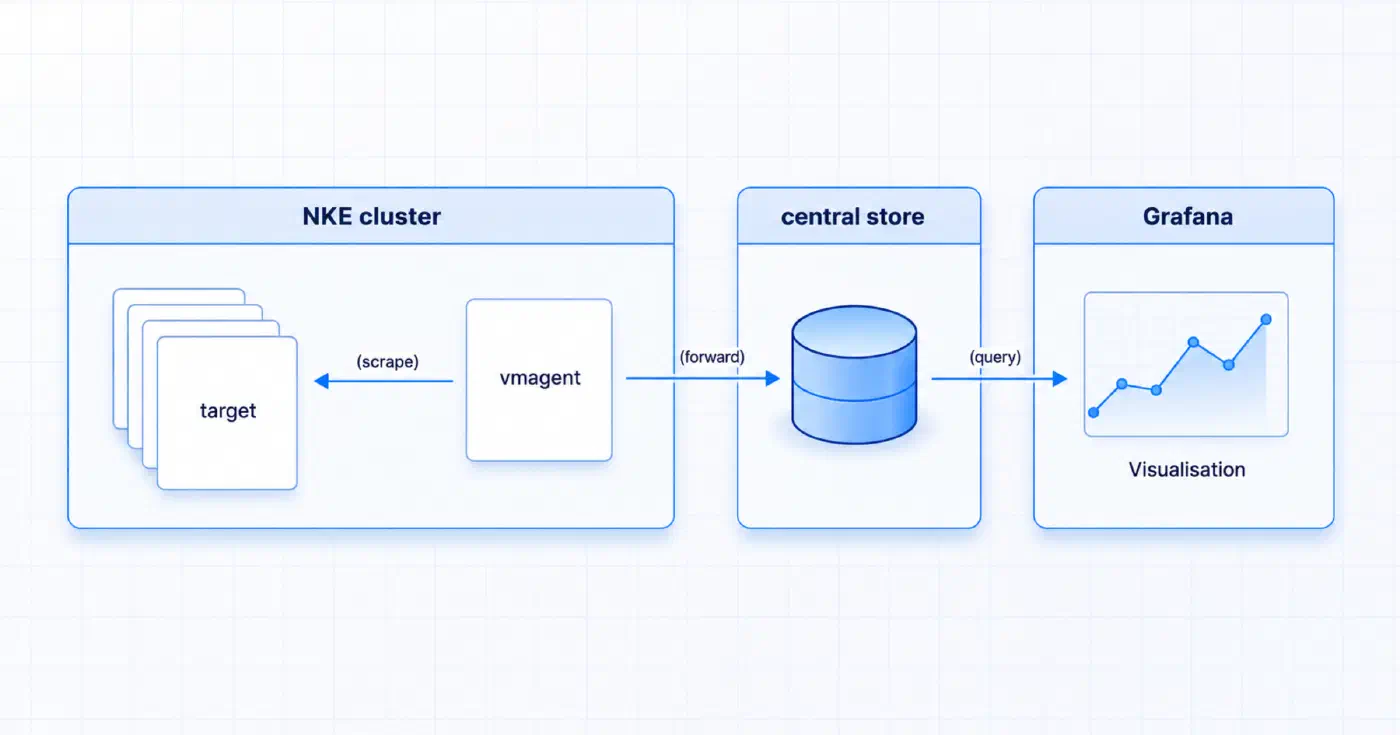
- Full observability stack: Prometheus, Grafana, Loki, and Alertmanager (preconfigured from day one)
- GitOps with ArgoCD, cert-manager, secret management via External Secrets Operator, and backups
- Swiss data residency: no CLOUD Act, no FISA, nDSG and GDPR compliant
- 99.5% uptime SLA
- Managed Databases, Object Storage, and Managed Caches directly integrable (no ecosystem switch required)
- CKA-certified engineers as direct contacts
Where our limits are:
- No free starter tier: the entry cost is higher than Exoscale
- Less ecosystem breadth than hyperscalers
- Primarily focused on the Swiss and DACH market
Makes sense when: You want to outsource the full operations burden, Swiss data sovereignty matters, and you prefer a direct contact person.
Decision guide
| Self-hosted | Exoscale SKS | Hyperscaler | VSHN | Swisscom K8s | Infomaniak | NKE | |
|---|---|---|---|---|---|---|---|
| What is managed? | Nothing | Control plane | Control plane | Full stack | Full stack | Control plane | Full stack |
| Node upgrades managed | ❌ | Partial (PRO with Karpenter) | Partial | ✅ | ✅ | ❌ | ✅ |
| Observability included | ❌ | ❌ | ❌ | ✅ | ❓ | ❌ | ✅ |
| Swiss data sovereignty | ✅ (infra-dependent) | ✅ | ⚠️ CLOUD Act | ✅ | ✅ | ✅ | ✅ |
| Swiss ownership | ✅ (infra-dependent) | ⚠️ A1 Telekom Austria (AT) | ❌ US company | ✅ | ✅ (majority Swiss Confederation) | ✅ | ✅ |
| Entry cost | Low (hidden ops cost) | Free (starter) | Low to free | Medium–High | Not publicly disclosed | Free (Shared) | From CHF 305.30/month |
| Internal ops burden | High | Medium | Medium | Low | Low | Medium | Low |
| Platform lock-in | None | None | Partial | OpenShift (Red Hat) | ⚠️ KKP (Kubermatic) | None | None |
| Personal support | – | ✅ Pro/Enterprise plan | ❌ | ✅ | ✅ Enterprise | ❌ | ✅ CKA-certified |
From GKE to NKE: When the CLOUD Act becomes the trigger
A common starting point for evaluating NKE is an existing GKE setup. Teams that have been running well on Google Kubernetes Engine but face pressure due to data protection requirements, compliance audits, or customer mandates ask themselves: how much effort does a migration involve?
A concrete example from our practice: mühlemann+popp was managing an application for a healthcare client who required medical data to be processed exclusively in Switzerland. Google Cloud with customer-managed encryption keys was not sufficient for the client, as the CLOUD Act was the deciding argument. The application was running on GKE; what was needed was a solution that behaves analogously but runs on Swiss infrastructure.
The migration to NKE went through without significant downtime and stayed within budget. The main adjustment was the storage layer: Google Cloud Storage was replaced with our S3-compatible object storage. ArgoCD, Grafana, and Loki were taken over and managed by us from day one. Silvan Mühlemann, CTO and Co-Founder of mühlemann+popp, puts it this way:
«Nine supported us optimally with their managed Kubernetes solution to migrate our client’s application from Google Cloud to a purely Swiss infrastructure.»
A migration from GKE to NKE is not a rebuild. Teams running on standard Kubernetes without proprietary GCP dependencies face a clearly manageable effort. We support the process with consulting, proof of concept, and migration.
Conclusion
There is no universally right answer. Self-hosted only makes sense with a dedicated platform engineering team. Exoscale is a good fit for teams that know Kubernetes well and only want to outsource the control plane. Hyperscalers are the right choice for global scale, provided data sovereignty is not a concern. VSHN (APPUiO Cloud / VSHN Managed OpenShift) is a strong fit for teams with OpenShift experience or in heavily regulated environments that need an enterprise-grade managed platform on Swiss infrastructure. Swisscom Sovereign Kubernetes Service is an option for larger enterprises with existing Swisscom relationships and strict Swiss sovereignty requirements. Infomaniak is worth evaluating if you already use their ecosystem and need a free Swiss entry point with in-house Kubernetes expertise.
NKE is the right choice when your team wants to minimise platform operations overhead and ensure Swiss data sovereignty, and without OpenShift dependencies. Including when the starting point is an existing GKE setup.
If you’d like to know which option fits your setup, we’re happy to talk:
Or start with our Kubernetes checklist:
